


The CENMAC Story
CENMAC has a long history of helping children and young people overcome barriers to communication and learning through technology.
Our beginnings
CENMAC was originally established in the 1960s and was known as CENMACH, which stood for Centre for Motor and Associated Communication Handicaps.
Today, we are known as CENMAC – Centre for Micro-Assisted Communication.
In the 1960s, it became clear that some physically disabled children needed technology to help them write and take part in classroom activities. Some children were unable to control a pen or pencil and were therefore unable to fully participate in learning.
The work of Edna Nicol
Edna Nicol, a teacher with experience in commercial typing, worked at a special school within the Inner London Education Authority (ILEA).
When the ILEA wanted a teacher to research the needs of children who could not write independently, Edna applied for the role. She was selected and spent a year researching the use of writing aids.
In 1968, her research was completed in a thesis about writing aids. She then became the first director of the new ILEA Resource Centre for Motor and Associated Communication Handicaps, based at Charlton Park School.
Edna remained director until her retirement in 1985.
Developing assistive technology
With support from Dr Marie Roe, then Senior Staff Inspector for Special Education, the Centre grew as more children with complex physical disabilities joined ILEA schools.
Many of these children had very limited movement and little or no speech. Edna demonstrated that, with patient and sensitive teaching, children could develop the confidence and skills needed to use specialised writing equipment operated by a switch.
This opened up new opportunities for children to communicate, learn and participate more independently.
Innovation and communication technology
In 1979, Edna was approached by Patrick Poon, a postgraduate electronics student at King’s College London. Patrick was researching ways to increase the speed at which people could write using communication aids.
The Resource Centre became involved in this research project. The work went on to benefit many children and adults, both in the UK and internationally.
As technology developed, children with significant physical disabilities were able to write, draw and use synthesised speech.
Supporting schools and teachers
By 1986, the Centre was supporting teachers across the ILEA who worked with children whose education was affected by difficulties with speech, writing or physical access.
The Centre provided:
- Advice about communication aids and assistive technology
- Guidance on equipment and teaching approaches
- Equipment loans to special schools
- Advice about suitable writing aids
- Support for children with special educational needs accessing mainstream education
CENMAC today
CENMAC continues to build on this history of innovation, inclusion and person-centred support.
Today, we work with children and young people to help them overcome barriers to communication, learning and participation through assistive technology and augmentative and alternative communication (AAC).
While technology and education continue to evolve, our aim remains the same: to help every child and young person have the opportunity to communicate, learn, achieve and reach their potential.
‘A Voice for All’ celebrates the history of CENMAC and 50+ years of assistive technology in education. The most important thing you can give to people with disability is a voice.
This film shows how advances in technology over the last 50+ years have had a major impact on improving the lives of people with disabilities helping them to communicate and gain access to education that would have been difficult or impossible without access to the technology.
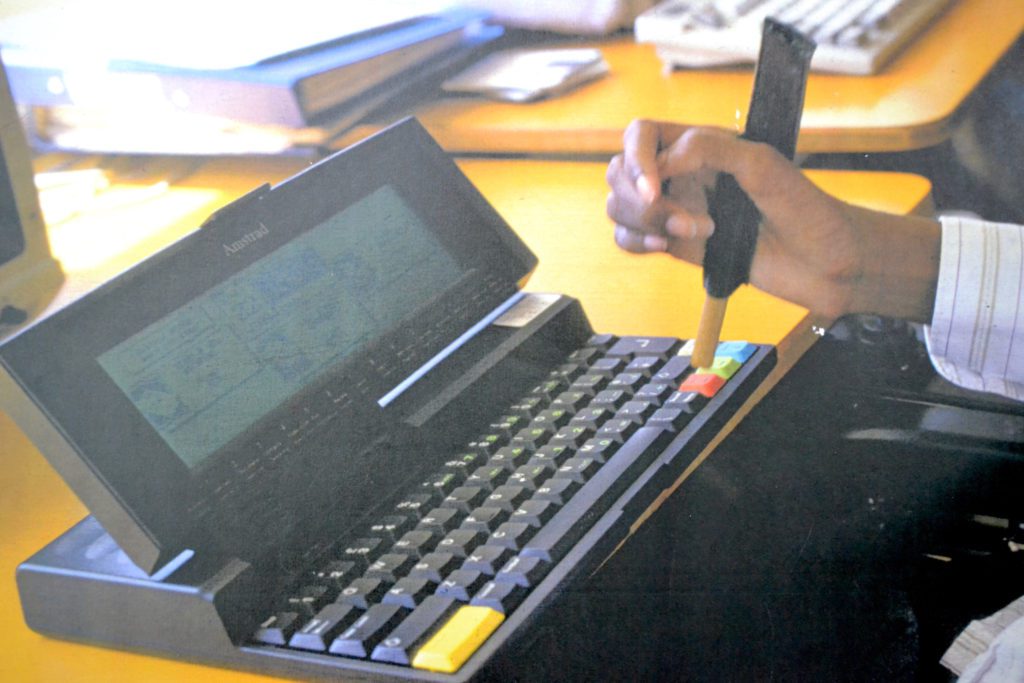
Amstrad NC100 with stylus. Archive photo (c) CENMAC.
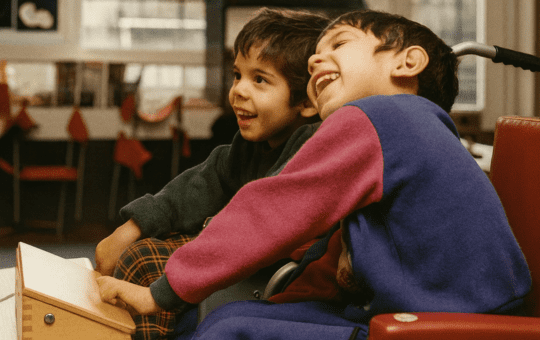
Two boys playing with a wooden switch. Archive photo (c) CENMAC.