


Modelling AAC
Recorded: Thursday 26th February 2026
CENMAC Advisory Speech and Language Therapist Jenny Zentner shares strategies for Modelling AAC – when/where/who and how to model AAC to support the child or young person’s power based AAC development.
Please note: In her presentation Jenny refers to a number of videos and resources – these videos could not be recorded as part of the session, however we have provided the links to all the videos below and resources mentioned below.
AssistiveWare – Modeling with AAC
AAC modeling works and it’s supported by decades of research. Modeling simply means that we use AAC to talk with the AAC user. Watch as Amanda shows you how to model and answers your most frequently asked questions.
The AAC Coach – Modeling Without Expectation
Learn how to use AAC effectively without pressuring your student. This video demonstrates modeling AAC during everyday interactions, from meals to playtime. Observe practical examples of authentic communication and connection.
Cookies and CORE
An afternoon in our kitchen using Philip’s Indi and a mixer with a PowerLink switch from our friends at Talk With Me Tennessee. Real life AAC in action!
What Are Core Words? Vocabulary to Increase Communication
Presenter: Rachel Madel SLP
Is your child stuck using single words or having a hard time creating sentences? This video outlines how to be more strategic with the vocabulary you are choosing and why a “Core Word” approach helps children start speaking in sentences beyond simple requests like “I want.”
Take a look at Rachel Madel’s website to learn even more about supporting AAC.
Access Rachel Madel’s AAC Freebie Vault.
AssistiveWare – Learn how to attribute meaning with your AAC user
Attributing meaning is an important communication partner skill. It allows us to connect with someone learning to use AAC. It can guide how we model with AAC.
AAC Group Therapy: Commenting
Our boys attend a monthly group therapy session at the amazing Vanderbilt Bill Wilkerson Center. In this clip our friend the bear was playing in a puddle and got very wet… “Oh no!”
Commenting is an important part of conversation and this was a fun way to practice.
Exploring with Explorer: Embedding TD Snap within the curriculum
In this 30 minute webinar SEND Lecturer Claire McReynolds presents her case study on taking a universal approach to high tech AAC within an FE environment. She follows the journey of Explorer and discusses the progress and challenges faced along the way.
Presenter: Claire McReynolds, SEND Lecturer, New City College – Havering with an introduction by Jenny Zentner, CENMAC Advisory Speech and Language Therapist
Empowering voices through the implementation of Grid – Clockhouse Greenland’s AAC Journey
In this 30 minute session discover how Clockhouse School has developed a SEND provision that promotes autonomy through both paper-based and powered AAC tools. This session shares the school’s journey in creating a communication-rich environment where every learner is supported to express their thoughts, needs and ideas. Learn about the strategies, challenges, and positive outcomes that have shaped their inclusive approach.
Presenters: Faye Howlett, SEND Provision Teacher, Clockhouse School with an introduction by Jenny Zentner, CENMAC Advisory Speech and Language Therapist
Smartbox – What is Simple AAC?
Smartbox’s Simple AAC framework brings together all the key ideas about how we can help support early AAC learners to develop their communication skills.
Each letter of Simple AAC represents a different strategy, including modelling and making it interesting, to think about the different ways we can respond to AAC users.
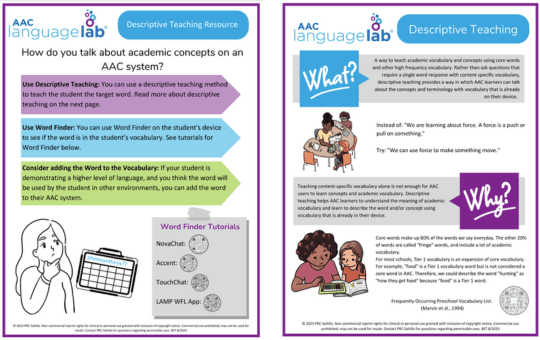
AAC Language Lab – Descriptive Teaching Resource
How do you talk about academic concepts on an AAC System?
Use Descriptive Teaching: You can use a descriptive teaching method to teach the student the target word.
Download the resource to read more about descriptive teaching.
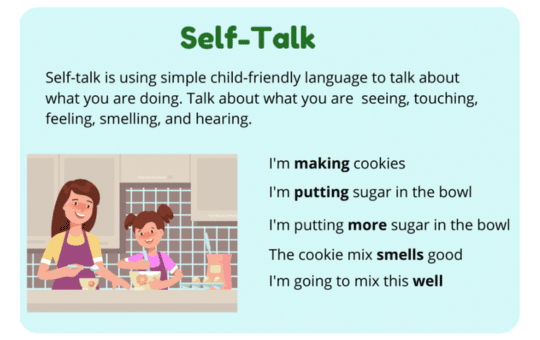
Avaz Inc. Using Self Talk and Parallel Talk for Language Stimulation
Language stimulation strategies play a significant role in emergent communicators developing their communication and language abilities. Strategies such as Self Talk and Parallel Talk help children learn to participate in back-and-forth communication, gain more expressive and receptive vocabulary, and use language for several communicative functions. They also help in extending their sentence length and pick up grammar skills.
When we employ stimulation strategies, we enable children to use language and communicate more. We can use any interaction as an opportunity to develop language. This way, children get to learn how to use it in natural environments and different settings.
Smartbox – A guide to Modelling
What is modelling? Modelling is essentially showing someone how something is done. It’s demonstrating how to use AAC by participating and using an AAC device yourself.
Modelling and showing is also sometimes called aided language stimulation.
When children learn to communicate using natural speech we all model without even realising it!
We show them how to communicate by talking around and to them using our own speech all the time. People learning to use AAC don’t have the advantage other learners have of seeing speech being demonstrated every hour of every day. This is why modelling can be so important, to show a child how to communicate using their AAC.
