


Highlights from the BATA AGM
Kathryn Stowell, Mary Long, Carys McCloskey and Maureen De Longhi recently attended the BATA Annual General Meeting (AGM) — a chance to connect, share updates, discuss all things assistive technology, and strengthen the community.
The AGM provides an opportunity to update members on BATA’s activities and outline future plans. Here are our key highlights from this year’s meeting.
Leadership Announcement
We’re delighted that Mary Long, Deputy Head at CENMAC, has been appointed as a Director of BATA.
This is a fantastic achievement that recognises Mary’s expertise and long‑standing commitment to improving assistive technology provision across the United Kingdom.
Her new role strengthens the connection between CENMAC’s practical experience and national policy development — a proud moment for our whole team.
Learn more about Mary, and the other members of the board, on the BATA Team website.
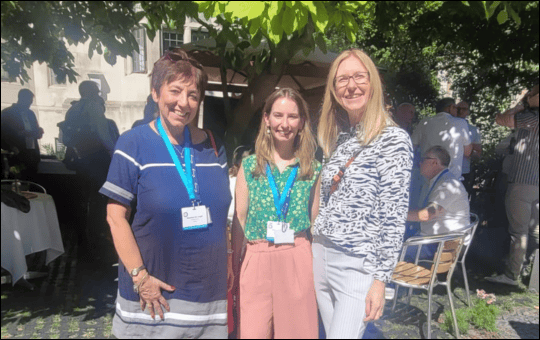
Photo: From left to right Advisory Teacher Maureen De Longhi, Advisory Teacher Carys McCloskey and CENMAC Deputy Head Mary Long
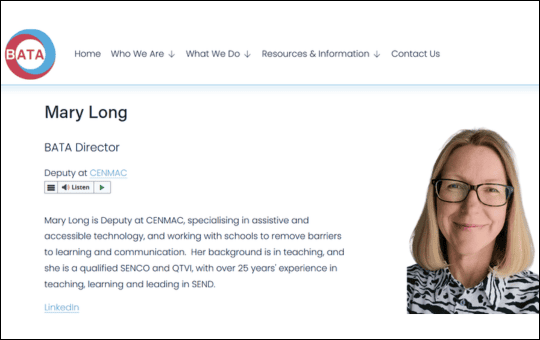
Mary Long, Director at BATA
DSA Consultation
Presentation by Lee Chambers, BATA DSA Lead
The Department for Education has proposed major funding cuts to the Disabled Students’ Allowance (DSA).
Key concerns include:
Removal of funding for non‑specialist spelling, grammar and punctuation software, with the claim that free tools are sufficient.
BATA’s response challenges this assumption:
- Specialist tools exist for a reason — they are designed for academic contexts.
- Free tools have not undergone formal academic testing or comparison with specialist assistive technology.
- Students with “exceptional circumstances” may still qualify, but no criteria have been published.
You can still show your opposition by signing the petition and writing to your MP to express opposition.
Dyslexia – Presentation by the British Dyslexia Association (BDA)
Key research insights:
- Rates of dyslexia diagnosis continue to rise.
- Dyslexia often leads to lowered expectations, especially when support is inconsistent.
- The DSA proposals risk widening this gap — free tools are not equivalent to specialist support.
- Assistive technology can significantly reduce cognitive load, enabling students to demonstrate their true abilities.
- Rising numbers of young people Not in Education, Employment or Training (NEET) correlate with students leaving school with undiagnosed or unsupported dyslexia.
The core message: assistive technology unlocks potential and provides tools that allow students to access their abilities.
Access to Work – Presentation by The Sycamore Trust
Key points:
- The government’s strategic reform of Access to Work currently lacks a clear, efficient process.
- Responsibility appears to be shifting back to employers, though details remain unclear.
- Significant funding cuts are expected.
- The Access to Work Practitioner Network continues to share information and coordinate campaigns.To explore Access to Work guidance further, or to add your contributions, you can contact alice@sycamorebusiness.co.uk.
Accessibility at Regent College
Regent College shared its structured approach to improving accessibility through three main initiatives:
Staff Training
– Delivered through Teaching with Tech Tips (TTT).
– Short, accessible content shared via Teams channels — quick reads or short videos.
Learning Management Systems
– Accessibility checks built directly for all published materials.
Microsoft Accessibility Tools Training
– College-wide implementation and training.
– PowerPoint, the most widely used Microsoft tool globally, is a particular focus for accessibility training.
Main takeaway: With the right technology and training, education can be made accessible for all. Something that CENMAC has always championed.
BATA Membership
Membership of BATA is open to anyone with an interest in assistive technology, including educators, disability advocates, researchers, universities and organisations providing AT products or services.
Membership is designed to bring together professionals from across the sector to share knowledge, collaborate on projects, influence policy, and improve outcomes for disabled people of all ages.
BATA offers individual, academic and organisational membership options, along with access to networking opportunities, special interest groups, industry events and a growing community of assistive technology specialists from across the UK.
If you are a teacher, teaching assistant, or anyone else interested in assistive technology in education, you can also join #TeachersforAT – a free to join trusted community of like-minded professionals, where you can share experiences and collaborate.
For more information and to discuss membership options, email BATA’s Head of Operations, Claudia: claudia.awoodun@bataonline.org.