


Background
We first met Kelson, a student from Barking and Dagenham, in October 2024 after the college contacted us to explore whether there were ways we could support him in accessing his course. Kelson had recently started a Computer Games Design course at the college. As part of the course, Kelson was required to draw, design and animate characters using college computers.
Due to Kelson’s physical condition, using standard college computer equipment was extremely challenging. Although Kelson uses an adjustable wheelchair and was able to raise the height to access the desk, fine motor control, posture and sustained use of the college devices made drawing and design tasks very difficult for him.
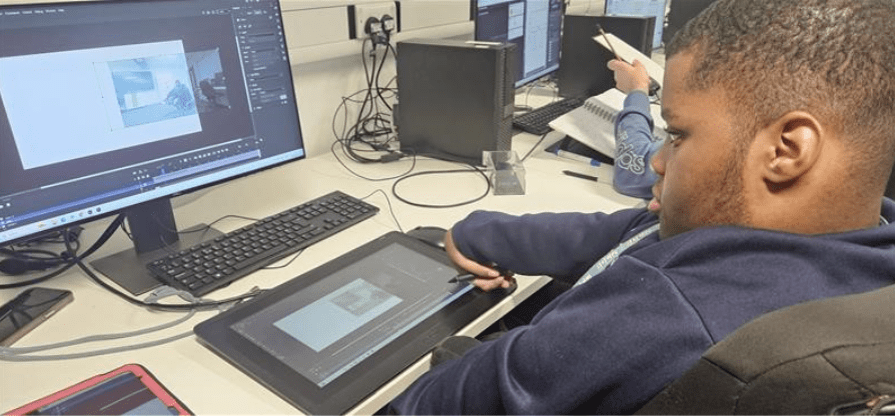
Kelson
Initial Engagement and Pre Assessment
An initial pre assessment visit was arranged with Kelson his tutor Alabar and the Head of ALS at the college. The purpose of this visit was to explore Kelson’s needs, understand the course requirements, and determine whether effective support could be put in place.
The visit was extremely positive. Following this, we supported the college in writing a referral for Kelson. As Kelson was the first student from Barking and Dagenham that the authority had referred for this type of support, there was limited prior knowledge of what could be provided. To assist with decision making, a detailed pre assessment report was written, outlining potential support strategies and providing an overview of indicative costs.
After several discussions and email exchanges, Barking and Dagenham agreed to proceed with a full assessment.
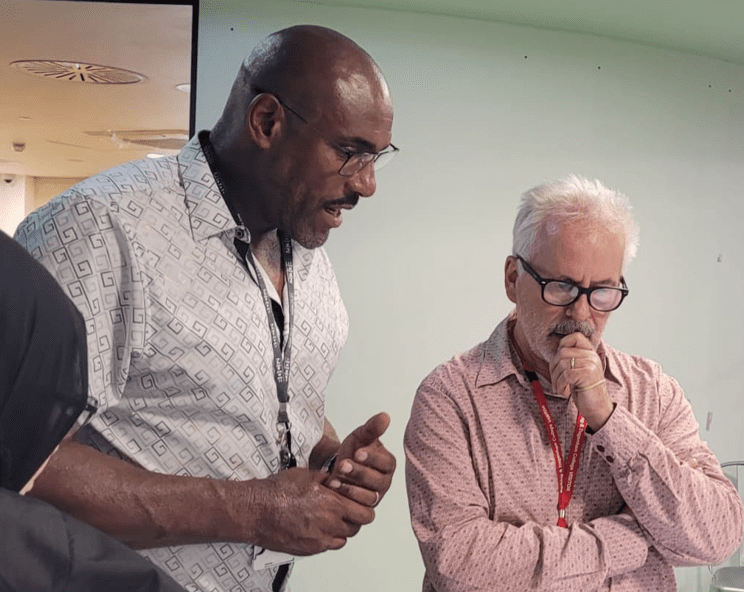
CENMAC Advisory Teacher David Howard with the Head of ALS at the college
Full Assessment and Trial of Equipment
In February 2025, a full assessment was carried out by Advisory Teacher David Howard and Charlie Danger, Advanced AT Practitioner and Specialist Occupational Therapist. During this assessment, Kelson trialled a wide range of assistive technology, accessibility tools and devices to identify what would best support access to drawing, design and animation tasks.
It became clear very quickly that Kelson’s preferences were central to success. Kelson was very clear that he did not want to look different from peers and did not want large, bulky or specialist looking equipment. Maintaining independence and fitting in with classmates was extremely important for him.
Based on this, Advisory Teacher David Howard initially agreed on a Microsoft Surface Pro mounted on a reading slope, allowing a more comfortable posture for drawing. This solution helped to some extent and was trialled for several months.
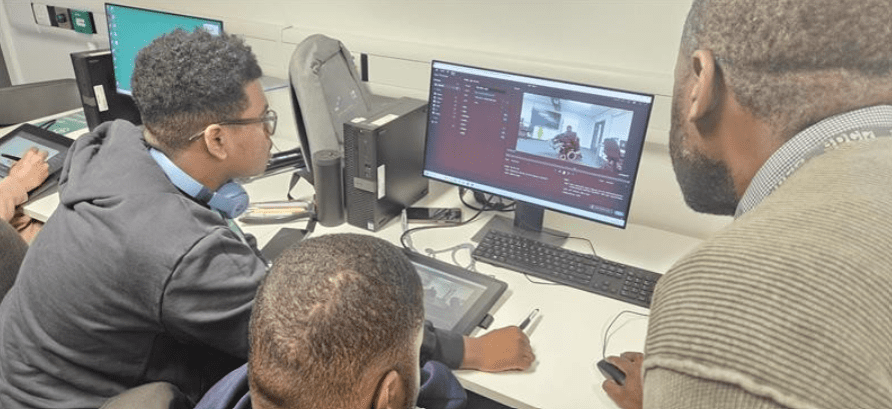
Kelson with college staff and his equipment
Refinement of Support
Following continued monitoring, it became clear that while the initial setup helped, it was not fully meeting Kelson’s needs. As a result, the support package was refined to include a digitising graphics tablet.
The tablet provided was the same manufacturer and style as devices already used by the college, ensuring it blended in with existing equipment. However, this particular tablet was fully personalised and configured to suit Kelson’s physical needs and working style.
This adjustment made a significant difference to Kelson’s ability to draw accurately, comfortably and independently.
Learning Environment and Peer Support
One of the most positive aspects of this case has been the learning environment around Kelson. Kelson’s course tutor is exceptionally supportive, and the wider class group has been equally encouraging.
A poignant moment was when I spent time working with Kelson in the classroom alongside his peers. After a bit of training, fellow students were happy to help with setting up equipment, offering help when Kelson needed it, and providing general encouragement. It has been genuinely uplifting to see such collaboration and peer support, and it has played an important role in Kelson’s confidence and independence.
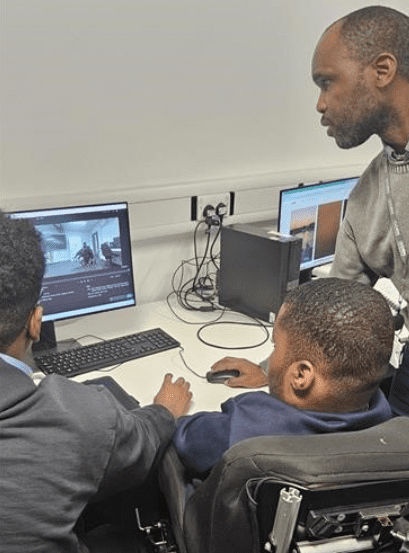
Kelson with college staff and his equipment
Outcomes and Progress
When we first began working with Kelson, he was unable to draw even simple shapes, such as an apple. Pen grip was awkward, control was limited, and drawings consisted largely of unrecognisable marks.
Over the course of a year, Kelson has made remarkable progress. Kelson can now:
• Draw detailed, realistic human forms
• Create and manipulate digital artwork independently
• Animate images
• Successfully complete complex design tasks
Kelson is currently achieving Distinction level grades on his Level 2 Computer Games Design course and is progressing onto the next level of study next year.
Kelson has developed into an independent learner, using equipment and software confidently. During a recent visit to the college, David found himself in an unexpected near miss with what can only be described as a high velocity fly-by from a motorised wheelchair. While walking across the grounds, David was almost knocked off his feet by a sudden blur of motion. He turned around just in time to see Kelson racing toward him at impressive speed, laughing and smiling. This moment perfectly captures his big personality, his enthusiasm, and his unmistakable joy for life.
With continued progress, there is no reason Kelson could not pursue a future career in game design or animation.
Equipment and Software Used
Kelson’s setup is intentionally simple and off the shelf, demonstrating that effective support does not always require specialist or expensive equipment:
• Microsoft Surface Pro
• Microsoft Surface Pro stylus
• Wacom Cintiq 16 digitising tablet and pen
• Reading slope
Software used includes:
• Microsoft Office 365 – Accessibility Tools
• Adobe Creative Suite (including Photoshop)
• Krita Digital Graphics Design software
• Blender animation software
All software packages are mainstream, industry standard tools, provided by the college and personalised where necessary to meet Kelson’s access needs. This is vitally important to equip Kelson with the skills to use mainstream software accessibility tools which give him independence and a skill set that is directly transferable into the creative industry.
Conclusion
This has been a fantastic success story from start to finish. Through collaborative working between the student, college, local authority and specialist support, Kelson has been enabled not only to access the curriculum, but to thrive within it.
The combination of personalised technology, an inclusive classroom environment and ongoing support has allowed Kelson to reach their potential and build a strong foundation for future study and employment.
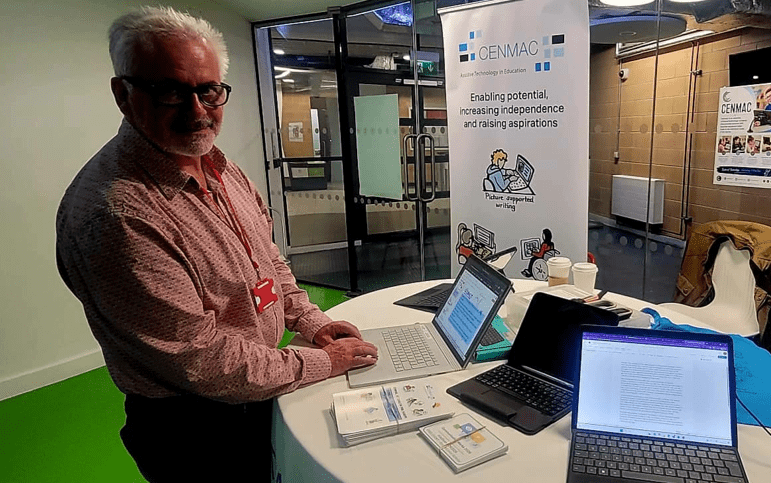
Advisory Teacher David Howard providing support at the college